
C O R P U S I I · U S R E F L E C T I O N
Fifth article of the series. Companion to Mathematical Fusion, The Orality of Time, The Debt You Must Come and Fetch and Policing the Marketplace, the Right Way Round.
“If you persist in walking into dead ends, then fortune will pass under your nose.”
— written on a whiteboard, at dawn
I. A law with no author
A principle in economics holds that for every winner there must be a loser. It is stated as one states the freezing point of water — as an elementary rule that only the naïve would question. The pie is fixed, the reasoning goes; whatever one hand gains, another hand has surrendered. Economists themselves have a name for this way of thinking when they wish to keep it at arm’s length: the zero-sum game, or, in its cruder form, the fixed-pie fallacy. Yet the moment the conversation turns to debt, to trade, to competition, the same profession reasons as if the fallacy were a law of nature. There must be losers. It cannot be otherwise.
Notice, first, a curiosity of form. This supposed law has no author. Nobody discovered it; no theorem carries its name; no experiment established it. Try to trace the sentence to a mouth and you will find only the profession speaking in chorus, in the timeless present of dogma. And a law that cannot name its author is not a discovery — it is a convention that has erased its own signature. The distinction matters, because everything that follows in this article rests on it: what is presented to us as a fact of nature is, on inspection, a choice of manufacture. I intend to show where the loser is actually made — and it is not at the moment of exchange.
II. The price of the anticipated defect
Take the most ordinary of examples: a new car. The buyer signs, takes the keys, and drives out of the dealership. By the time the tyres touch the public road — before a single kilometre of use, before any wear whatsoever — the vehicle has lost, depending on the model, somewhere around ten percent of its value. Everyone knows this; nobody finds it strange. But pause on what it actually means. Nothing physical has happened to the car between the showroom and the kerb. No component has aged, no metal has fatigued, no paint has faded. What, then, is the market pricing at that precise instant?
It is pricing the anticipated defect. The manufacturer knows, statistically and before the sale, which parts will fail and roughly at what mileage. The failure is not an accident that may befall the product; it is a property designed into it, dated in advance like a bond reaching maturity. The second-hand market is, quite literally, the public quotation of the vice of conception. The discount at the dealership gate is not depreciation through use — there has been no use. It is the price of a flaw that exists from the drawing board, transferred to the buyer at the moment of signature and acknowledged by the market one minute later.
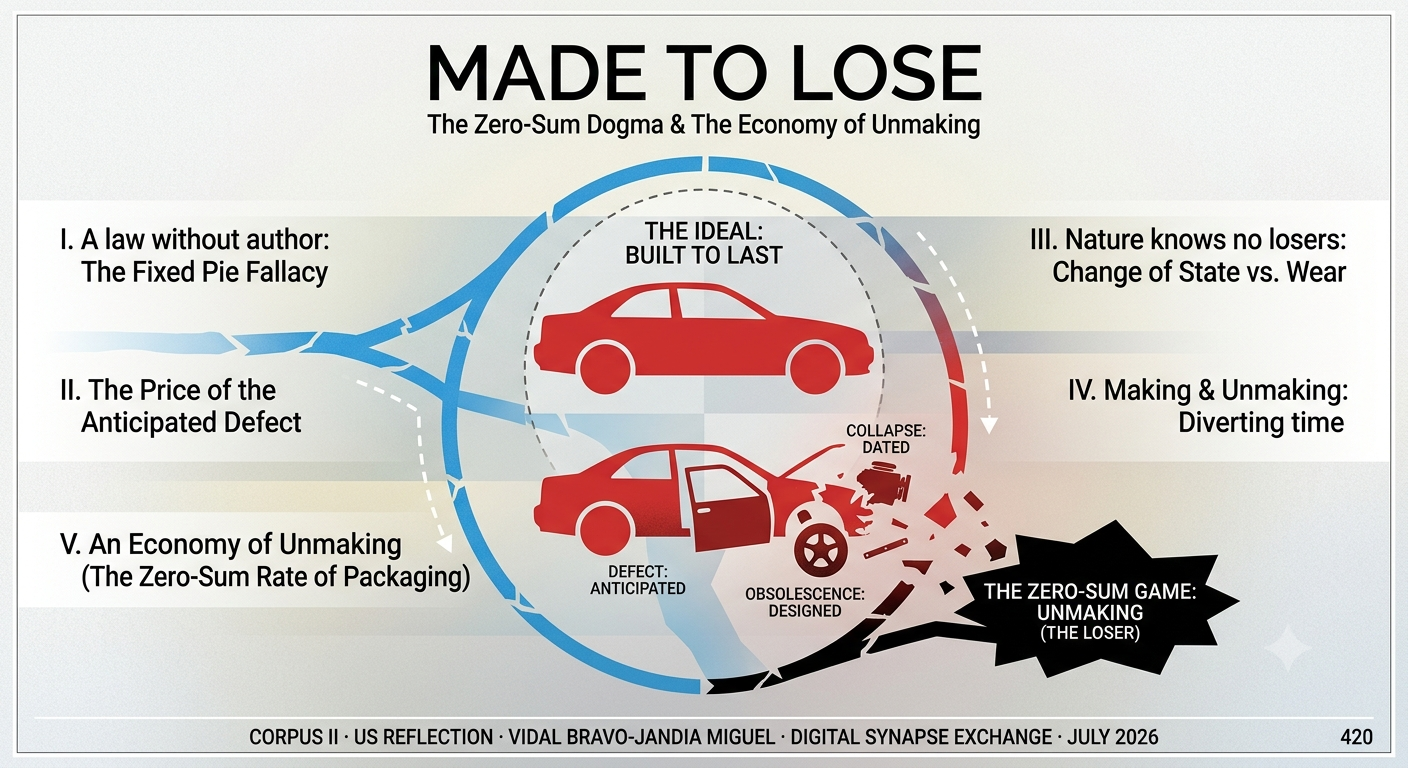
The law, for its part, has known this for over two thousand years — far longer than economics has existed as a discipline. The warranty against hidden defects (article 1641 of the French Civil Code, inherited from the Roman aedilician edicts) exists precisely because jurists were forced, very early, to recognise that the losing party in a sale is frequently manufactured upstream of the exchange, not produced by it. Modern French law went one step further and created a specific offence of planned obsolescence in the Consumer Code — a crime whose most famous ancestor is the Phoebus cartel of the 1920s, in which lightbulb manufacturers agreed to shorten the life of their bulbs from around 2,500 hours to 1,000. The law knows the loser is fabricated. The economist still calls him inevitable.
III. Nature knows no losers
The opening ends here.
You have just read the part that poses the problem. That is deliberately where open access stops. The corpus is a personal research project carried on since 1998, and the question has always interested me more than the conclusion.
Want to publish your own articles?
Join the Digital Synapse Exchange community and share your research.