
Ordinary counting says one and one make two. But where a man and a woman bring forth a child, counting fails: if they remain two, where does the third belong? Fusion is the operation that answers this — and it is not addition.
I. The operation
A. What addition cannot do
Addition preserves its terms. One and one make two, and the two are still there afterwards, side by side, countable: nothing has been consumed, nothing new has appeared. This is the great virtue of addition — and its limit. It juxtaposes; it does not engender.
Consider a man and a woman who bring a child into the world. If we hold to addition, we obtain a man and a woman — two — and the child must be added on top, giving three. But three of what? Addition never produced a third body; it only set two beside each other. The child is not a sum lying next to its parents. It is a new whole that was nowhere before. Addition has no room for it: it can place the child beside the parents, but it cannot say where the child comes from.
This is the decisive test, and it is worth stating as plainly as possible: one cannot reduce father, mother and child to two, for then the third one has no place to sit. The world contains the third body; addition does not. Something other than addition is at work.
B. Fusion
Fusion is that other operation. Where addition conserves its terms, fusion consumes them into a new whole. Its formula is not one plus one, but a half joined to a half:
½ + ½ = 1
The sign is the same “+”; the ontology beneath it is not. In addition the operands survive the operation — they remain discernible in the result. In fusion the operands disappear into the result: once the child exists, one cannot re-separate the paternal half from the maternal half as they were before. They have been consumed into a single indivisible one.
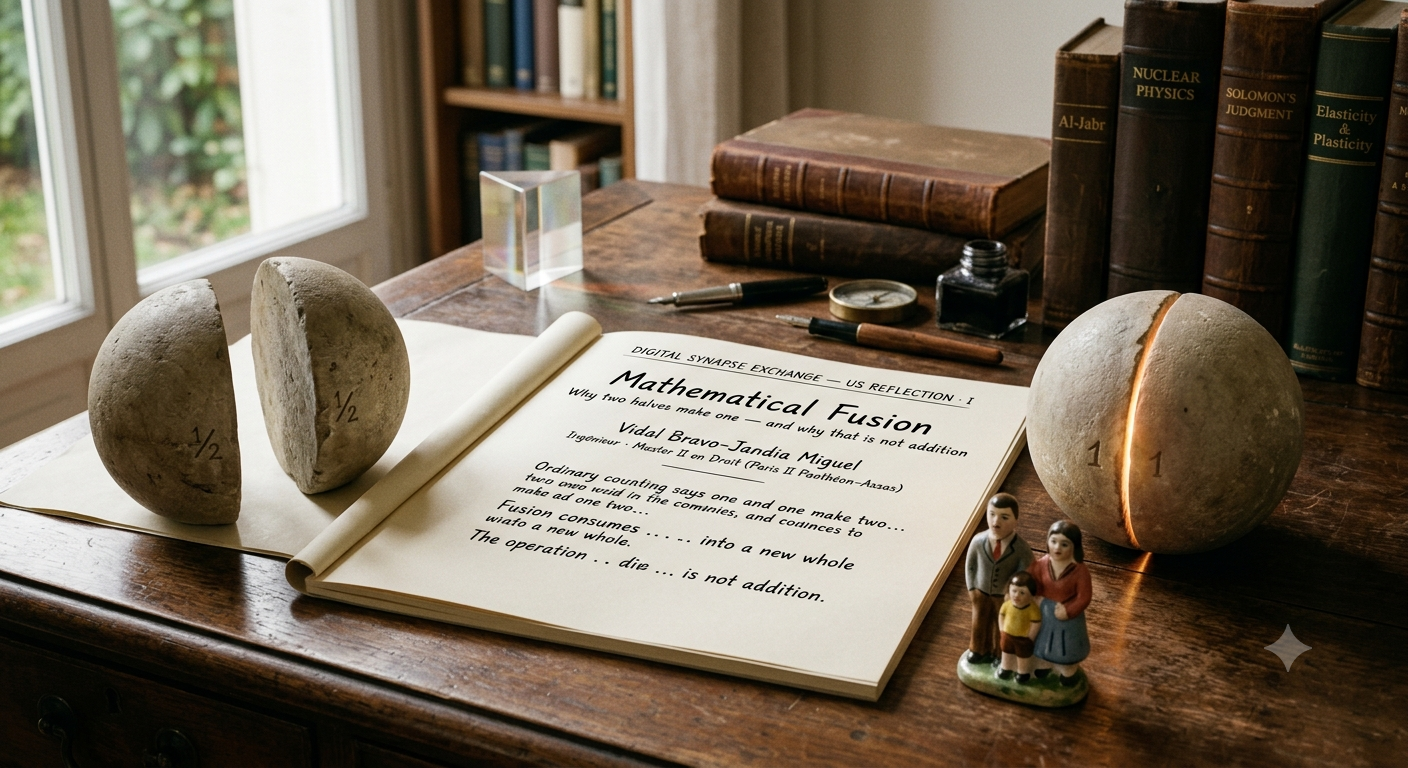
Nature signs this distinction. In nuclear fusion, two light nuclei merge, and the mass of the product is less than the sum of the masses that entered: the difference, the mass defect, departs as energy. The physical operation that bears the name fusion is precisely the one in which the sum is not conserved. That a corpus anchored on E = Mc⁴ should find its new operation named after the physical process where one plus one is refused — that is a convergence we did not manufacture. It was waiting.
II. The mechanism
A. Two planes: whole as body, half as cause
How can a man be both a whole — an indivisible body — and a half? Only by distinguishing two planes. As a body, the man is one: entire, undivided, and he remains so. As a cause, he is one half: alone, he engenders nothing; he is but half of a cause, and calls for the other half. His incompleteness is not bodily but generative. And it is precisely because he is one half on the plane of causes that he can cede only one half.
Where does that ceded half come from? Not from nothing — the corpus forbids creation ex nihilo. The half was already lodged, in potential, in the zero that contains. And here the notation is a choice, not a convention: usage often drops the leading zero and writes “.5”, but we write “0.5” deliberately — the zero inscribed within the number, the container written into the thing contained. To keep the zero is to keep the origin of the half in sight. The sequence is then clean, and violates nothing:
1 → 1.5 → 1
At rest, the parent is one, with a half held in potential. In the act of engendering, one and a half momentarily. In ceding, one and a half less one half returns to one: the parent’s body has lost nothing. The same for the other parent. And the two ceded halves fuse: one half plus one half make one — the child. We began with two bodies; we arrive at three; and we did so without addition, for no body grew, and without the void, for the halves came from the zero.
B. Elasticity
Do the bodies themselves fuse? Not durably. A man and a woman fuse only for the length of the interval — and then, like a material within its elastic limit, they return to their prior state. This is elasticity: deformation under load, recovery once the load is lifted. The bodies are elastic; only the ceded halves are plastic — they never return, they have become the child. Two regimes, divided by one frontier: the ephemeral.
That frontier is temporal, and it belongs to another study — the orality of time — which this article presupposes and does not repeat. It is enough to say here: the permanent are the ones (the bodies), the ephemeral is the act (the momentary one-and-a-half, the half in transit), and the passage runs through the zero, unseizable, the way time itself is never caught in the act of passing. We observe the departure and the arrival; the transfer between them we never see.
The universe confirms the reading. A star dies and passes to zero; from that zero a new star is born — but never exactly the same one: larger, smaller, denser, other. The zero conserves without repeating. And we ourselves are made of the matter of dead stars: descent among humans and descent among stars are the same conservation. What endures is made of what passes.
III. Consequences
The framework is not built to be admired but to be used. A reader who accepts it should be able to carry it into ordinary life and find that it cuts. It does.
The child belongs to no one wholly. Each parent furnished only one half of the cause; neither can claim the whole. And since the child is an indivisible one, the halves cannot be pulled back out. Solomon’s judgment says exactly this: to propose cutting the child in two is to pretend that fusion can be reversed — and the true mother refuses, because she knows it cannot. Every custody dispute that treats the child as a divisible good repeats the false premise: it applies the arithmetic of shares to a product of fusion.
The “fusional” couple is a category error — and a danger. The theory gives the criterion of health: fusion is legitimate within the interval; elasticity requires the return to one and one. A couple that claims to remain fused permanently passes from the elastic regime to the plastic one — the persons deform and no longer return. Emotional dependence is plastic deformation. To love elastically is to fuse in the act and remain whole between acts.
Grief has an arithmetic. The one who dies passes to zero — but the half was already lodged elsewhere, in each child, while the parent still lived. The consolation is not mystical but conservatory: nothing that was transmitted is in the void; all of it is in the zero, that is, carried. Succession did not begin at death; it began at the first ceded half.
The child is not a copy — and should not be required to be one. The new star is never identical to the dead one. The zero conserves without repeating. A parent who expects the child to reproduce his own trajectory confuses transmission with duplication, and denies the very nature of fusion, which makes something new out of what was ceded.
And negotiation — wherever humans decide together. A true agreement is a fusion: each party cedes a half within the interval of the talks (ephemeral: the offer does not endure), and from it issues a new one — the contract — which is the sole will of neither. The parties remain whole (elastic); the concession does not come back (plastic). An “agreement” in which one side has ceded nothing is not a fusion but an addition: the will of the strong plus the signature of the weak — the illusion of a discussion. The criterion is now arithmetical: no half ceded on each side, no commutative contract.
Wherever humans decide together, there is fusion, or there is nothing. Half plus half is one; one plus one, kept apart, is only two. The whole question of a just accord is whether each party truly ceded its half — or whether one merely signed.
Author
Vidal Bravo-Jandia Miguel
Ingénieur · Master II en Droit (Paris II Panthéon-Assas
References
al-Khwārizmī, Muḥammad ibn Mūsā, The Compendious Book on Calculation by Completion and Balancing (Al-jabr wa’l-muqābala), c. 820. — Encyclopædia Britannica
“Nuclear binding energy” and the mass defect (E = mc² in fusion). — Encyclopædia Britannica.
“Elasticity” and “Plasticity” (elastic limit; permanent deformation). — Britannica: Elasticity · Britannica: Plasticity.
Stellar nucleosynthesis — “star-stuff”: elements forged in stars that have died. — U.S. Department of Energy · NASA Astrobiology.
Code civil, article 1104 (good faith; public order). — Légifrance.
The Judgment of Solomon, 1 Kings 3:16–28. — USCCB.
DeMille, Cecil B. (dir.), The Ten Commandments, Paramount, 1956 (source of the attributed formula).
Want to publish your own articles?
Join the Digital Synapse Exchange community and share your research.