
CORPUS II — US REFLECTION
Concentrated security is sold as strength and delivered as a tomb. The summit of the pyramid — the single guarded point — is not an economy but a coffin, because concentration cuts three ways at once: fewer points to defend, fewer to attack, and fewer by which to escape. What follows walks the same figure from a door lock to the world's cryptography, then turns it around: the wall that reveals rather than blocks, and the moral hinge on which such a wall becomes either a trap for the thief or a cage for the people.
I. The Lock and the Coffin
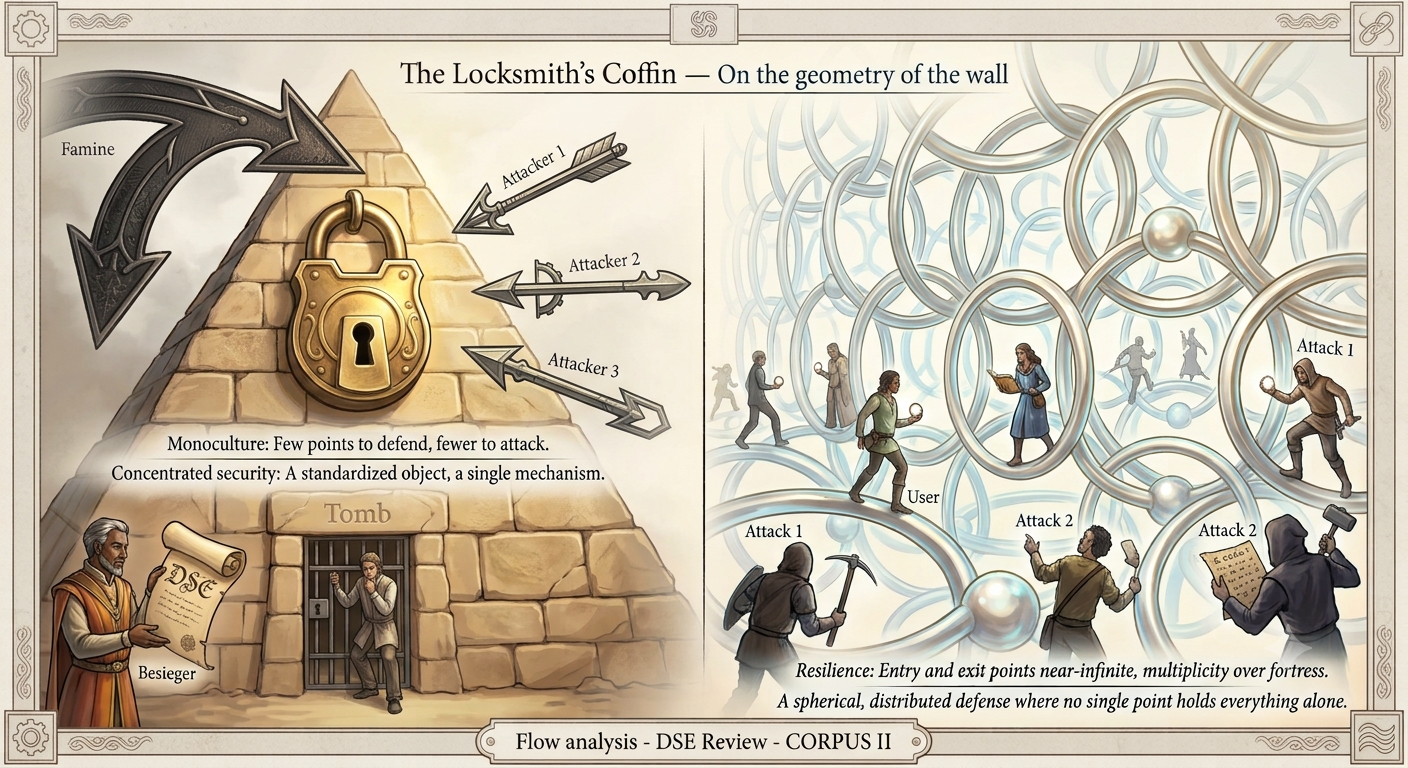
The lock is the archetype of concentrated security. A standardised object, a single mechanism — and it is precisely this concentration that constitutes its weakness. A picker need not learn your door; he learns the lock in general, because they all resemble one another. The bump key opens millions of doors with one gesture. In cybersecurity this is called monoculture: when everyone stands at the same summit of the pyramid, a single exploit serves for all. Three points of attack, known in advance, identical everywhere — the attacker knows precisely where to strike before he even arrives.
The castle that has but one gate to defend has also but one gate by which to leave. The besieger understood this early: he no longer attacks, he sits down before the gate and waits. Famine does the work. What protected becomes what imprisons — the economy of the guard becomes the economy of the gravedigger. The defenders have built their own snare.
RSA is this same figure at civilisational scale. All the world's security — banks, states, hospitals, communications — rests upon a single point: the supposed difficulty of factoring large numbers. No one has ever proven that factoring is hard; it has only been observed so, thus far. Shor's algorithm [1] is the bump key of this castle: the day a sufficient quantum machine exists, it is not one door that yields but all doors at once, because it was the same door. Attackers have understood this so well that they already practise the patient siege — intercepting and storing encrypted data they cannot yet read, waiting for time to do the work. The industry names it harvest now, decrypt later [2]. It is, literally, the besieger seated before the castle.
The official reply has been to standardise a few new algorithms — that is, to rebuild the pyramid with a new summit. Same schema, new castle. And the warning has already come: SIKE, a finalist thought solid after years of scrutiny, was broken in 2022 in a matter of hours on an ordinary laptop, by a mathematical attack no one had foreseen [3]. One summit, three points, one collapse.
II. The Line and the Sphere
Return to the drawing. The horizontal line is distributed defence: entry and exit points near-infinite, so no single point is worth learning by heart, and no attack generalises. It is the swarm and the archipelago carried into security — resilience by multiplicity rather than by fortress.
The honest objection must be met, for it explains why men place themselves at the summit: defending three points costs less than defending infinity. The lock's designer reasons as a thrifty defender — I reduce my openings. What he forgets is that reduction cuts both ways: he has reduced his own labour of watch, but he has also reduced the attacker's labour of search. The summit is economical for both camps, and the attacker need win only once.
The pyramid has a summit; the sphere has none. On a sphere every point is equivalent to every other — the line closed upon itself, infinite points and no privileged one. The attacker who seeks the top of the sphere seeks something that does not exist.
A structural engine reasons in the geometry of the line. Where the classical antivirus verifies one signature — a single point at the summit, a hash — a structural detector measures the entire equilibrium of the file across several independent criteria at once. The attacker cannot aim at a point, because it is the global balance that is measured. Mutate the surface all you like: the invariant beneath the mutation is what is read.
III. The Moving Wall
Polymorphism has, until now, been the attacker's weapon. Polymorphic malware mutates its appearance at each infection precisely so that the defence can never seize the door. The proposal is to turn the weapon around — to give the defence what has always served the attack. The wall that dances: what is a door or a window at t becomes a wall at t + a millionth of a second.
The field exists, still young: Moving Target Defense [4] — permanently randomising memory addresses, ports, network paths, the very topology of the system, so that the attacker's map expires before it can be used. Military frequency-hopping [5] has done this for decades: the radio changes frequency hundreds of times a second, and the interceptor forever listens to a door that already no longer exists.
The opening ends here.
You have just read the part that poses the problem. That is deliberately where open access stops. The corpus is a personal research project carried on since 1998, and the question has always interested me more than the conclusion.
Want to publish your own articles?
Join the Digital Synapse Exchange community and share your research.