Corpus II · US Reflection
The first article established that a thing keeps its state whether or not a witness is present. This one draws the consequence for chance. If the thing is full without anyone to note it, then chance is never in the thing — it is the gap between the full thing and the one who has not yet noted it. Chance is not a property of the world. It is a state of the knower. And what is a state of the knower can be produced, dosed, and sold.
I. The die does not hesitate
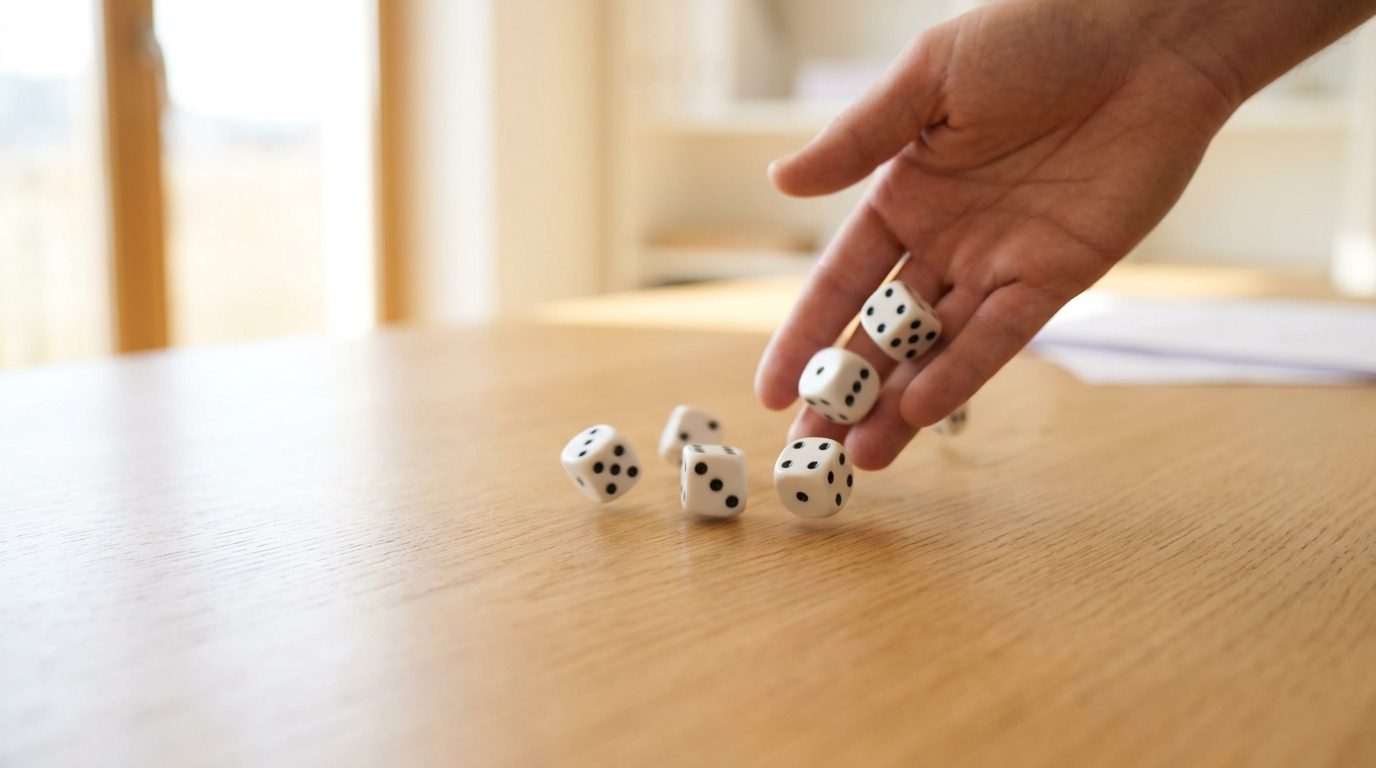
A die is thrown, and we call the result chance. Yet the die does not hesitate. The instant it leaves the hand, its fall is fixed — by the force of the throw, the angle, the friction of the table, the resistance of the air. The face that will show is already settled while the die is still in flight. Nothing in the die is undecided; everything in it is full. Remove the eye that watches it land, and it lands the same way. The chance was never in the die.
It was in us. More precisely, in the distance between what the die does and what we can compute of what it does. Give a mind the full initial conditions and the means to carry the calculation, and the result ceases to be chance and becomes a consequence. The word chance names, then, not a feature of the throw, but a shortfall of the one who names it. It is our retardation upon the thing, dressed as a property of the thing ¹.
Chance is not what the world contains; it is what we have not yet noted of what the world does.
II. The full thing before it is noted
This follows directly from the criterion of the witness. If the state of a thing does not depend on being noted — if its withdrawal changes nothing — then the thing is full: entirely determined in itself, without a gap. The gap is never in the thing; it is between the full thing and the knower who has not yet caught up. What we call the unknown is not a hole in the world. It is the part of the world our noting has not yet reached.
The strongest historical witness to this is a table of empty cells. When Dmitri Mendeleev arranged the elements in 1869, he left gaps and declared that elements would fill them — announcing the weight, the density, the behaviour of bodies no one had yet noted. Gallium, germanium: they were there, full, determined, acting as they act, before any eye had met them. Their discovery added nothing to them. It closed the gap in us. The undiscovered thing does not wait in a fog of chance; it holds its state and awaits only our arrival ².
III. What can be made can be sold
Here the consequence turns practical, and severe. If chance were a property of the world, no one could fabricate it or lift it at will — one does not manufacture a law of nature. But chance is a gap in knowledge, and a gap in knowledge can be held open on one side and closed on the other. It can be organised. It can be dosed. It can be traded.
Wherever one party knows what the other does not — and takes care that the other continues not to know — chance is not encountered, it is maintained. The gap is not a fact of the world between the two; it is a distance of information deliberately kept. What is sold under the name of chance is never a property of things. It is an asymmetry of noting, priced. The one who sells the unknown has first taken care that it remain unknown to the buyer, and known to himself.
The illustrations in this article were generated by artificial intelligence. They are not historical documents or authentic depictions.
The opening ends here.
You have just read the part that poses the problem. That is deliberately where open access stops. The corpus is a personal research project carried on since 1998, and the question has always interested me more than the conclusion.
Want to publish your own articles?
Join the Digital Synapse Exchange community and share your research.