
C O R P U S I I · U S R E F L E C T I O N
Companion piece to Mathematical Fusion (no. 408) and The Orality of Time (no. 416).
In the universe, the thing is done first; the observer only says, afterwards, what he observed. This corpus writes in that order.
There is an object on this site that was never introduced. It has been turning quietly in the editor since April 2026 — a globe, a cube inside it, a globe inside that cube, a cube inside that globe — and no article ever said what it was. This is that article, written three months after the thing itself, and the delay is not an accident: it is the method. The object came first. Here is the saying.
I. The Figure and Its Two Readings
Take a sphere of radius R. Inscribe a cube in it: the cube's side is 2R/√3. Inscribe a sphere in that cube: its radius is half the side. Inscribe a cube in that sphere, and continue. Two ratios alternate, and only two: 2/√3 when a cube enters a sphere, 1/2 when a sphere enters a cube. One full cycle — sphere to sphere — multiplies the scale by their product, exactly 1/√3. Not 0.577: exactly 1/√3. The chain keeps its remainder; it owes nothing to the decimal system and accepts nothing from it. This is the Theory of Exact Fractions applied to space itself.
Inward, the series converges toward zero without ever reaching it. Outward, it diverges toward infinity without ever completing it. The figure has no first term and no last term; it has only the rule. What classical geometry calls a “point” — the dimensionless mark where division is declared over — is nowhere to be found in it, because the point is not a property of space. It is a convention of resolution: the moment the instrument, or the mind, decides to stop dividing. Change the resolution and the point opens into a sphere, the sphere yields a cube, and the chain resumes. The limit belonged to the observer, never to the thing.
The chain exists in two formalized versions: one with the cube outermost, one with the globe outermost. They are not two objects. They are the same figure read in the other direction — as a word read from the right, as a ledger read from the bottom. Nothing in the figure tells you which way you are going. The direction is not in the chain; it is in the reader. Hold on to that sentence: the whole of Part IV rests on it.
II. The Two Opposed Pyramids, or the Completion of the Square in Three Dimensions
Inside the chain stand two pyramids, base to base with the cube, apexes opposed. They are older than the chain itself: they entered the figure in June 2025, when a single pyramid was replaced by two, set against each other so that together they compose a square or a rectangle according to what enters the outer frame. That condition is the point. The two pyramids do not decorate the figure; they interrogate it. Depending on the proportions of what they receive, their joint silhouette closes into the “perfect” square or settles into the rectangle — and the figure itself thereby asks the oldest question of measurement: is the square the ideal from which rectangles fall away, or merely the rectangle's limiting case, never actually attained by any physical measure? No two physical lengths are ever exactly equal; the perfect square is a decision, not an observation.
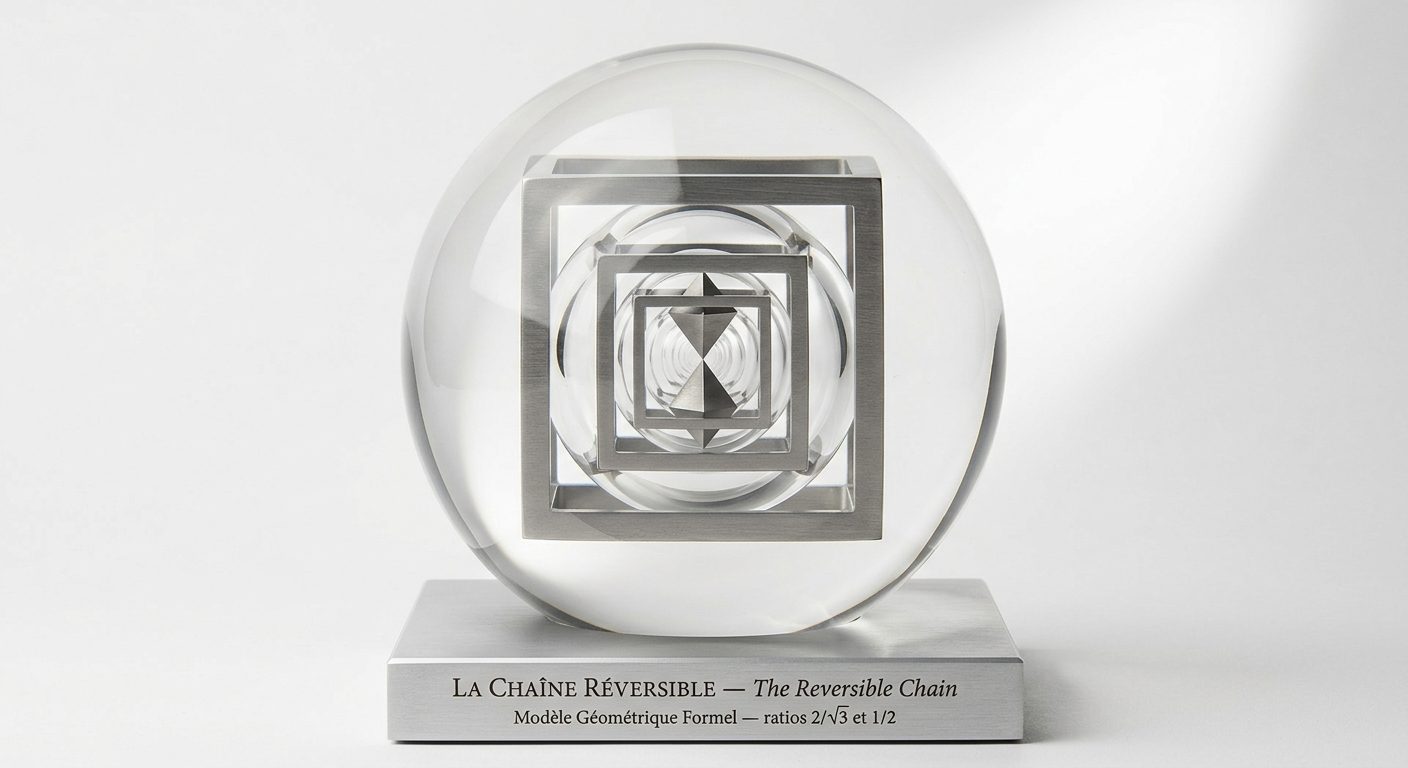
They also carry a lineage. In the ninth century, al-Khwarizmi invented al-jabr — literally the completion of the square: adding the missing area so that the form closes. Six centuries later, Leonardo drew the nested polyhedra of Luca Pacioli's De Divina Proportione — cubes, spheres, pyramids, the hidden harmonies of forms in space. The two opposed pyramids are the meeting point of the two gestures: what al-Khwarizmi completed by algebra and Leonardo would have drawn, the chain performs in three dimensions — with one inversion. Al-Khwarizmi completes; this figure conserves. He adds what is missing so that the square may close; the chain refuses to concede that anything was ever missing, or that anything may end. Two ways of saying that nothing must be thrown away.
And within the chain's alternation of curve and edge — sphere, cube, sphere, cube — the pyramids are the mark of balance: duality held inside continuity, the pair inside the series. Every other element of the figure repeats; only they are two and only two, facing each other. If the chain is the rule, the pyramids are its witness — the internal reminder that every reading of the figure is made by someone standing somewhere, measuring against something.
III. A Clock Without an Instrument
Look at the chain and you see space: nested forms, exact proportions, a structure. Traverse it and you see something else. Each inscription is a beat; the ratio is the period; the zoom is a flow. Sphere, cube, sphere, cube — 2/√3, 1/2, 2/√3, 1/2 — a tick that no external clock imposes and no external clock could correct, because it is not measured by an instrument: it is the constant of the object itself. The chain does not have a time. It emits one.
This is not a metaphor smuggled in from physics; it is what metrology itself already concedes without saying so. Since 1967, the second is defined as a fixed number of periods of the radiation emitted by the caesium-133 atom. Read it closely: the unit of time is defined by an emission. The atomic clock emits nothing — it counts what the atom emits. The instrument is the observer who says what he observes of the thing done; the source of time is the thing that beats. The official definition of the second is the thesis of The Orality of Time, written into international law of measurement, and nobody reads it that way.
The opening ends here.
You have just read the part that poses the problem. That is deliberately where open access stops. The corpus is a personal research project carried on since 1998, and the question has always interested me more than the conclusion.
Want to publish your own articles?
Join the Digital Synapse Exchange community and share your research.