
Digital Synapse Exchange — Corpus II, US Reflection
I. A stone on the ground
The conclusion, stated before it is earned.
There is a stone on the ground. I see it, and seeing it, I believe I have it. This belief is the quiet error at the root of a great deal of what we call knowledge, and it dissolves the moment it is examined — not because the stone is unreal, but because the seeing never reached it. What follows is not an accusation. Nothing here is broken and nothing is torn down. We will only look closely, and in looking closely we will watch the observed thing withdraw of its own accord, without our having pushed it.
Begin with the plainest fact, the one a scientist enacts without stating it. When a probe is sent across the solar system to scrape a spoonful of asteroid and carry it home, the mission confesses something the telescope could never admit: that looking is not enough. The Japanese craft that returned grains from a distant rock, the American mission that brought back dust from another, the Martian soil now sealed in tubes and left on the ground for a future hand to fetch — every one of these colossal, costly gestures says the same short sentence. To see is not to have. One must go and touch.
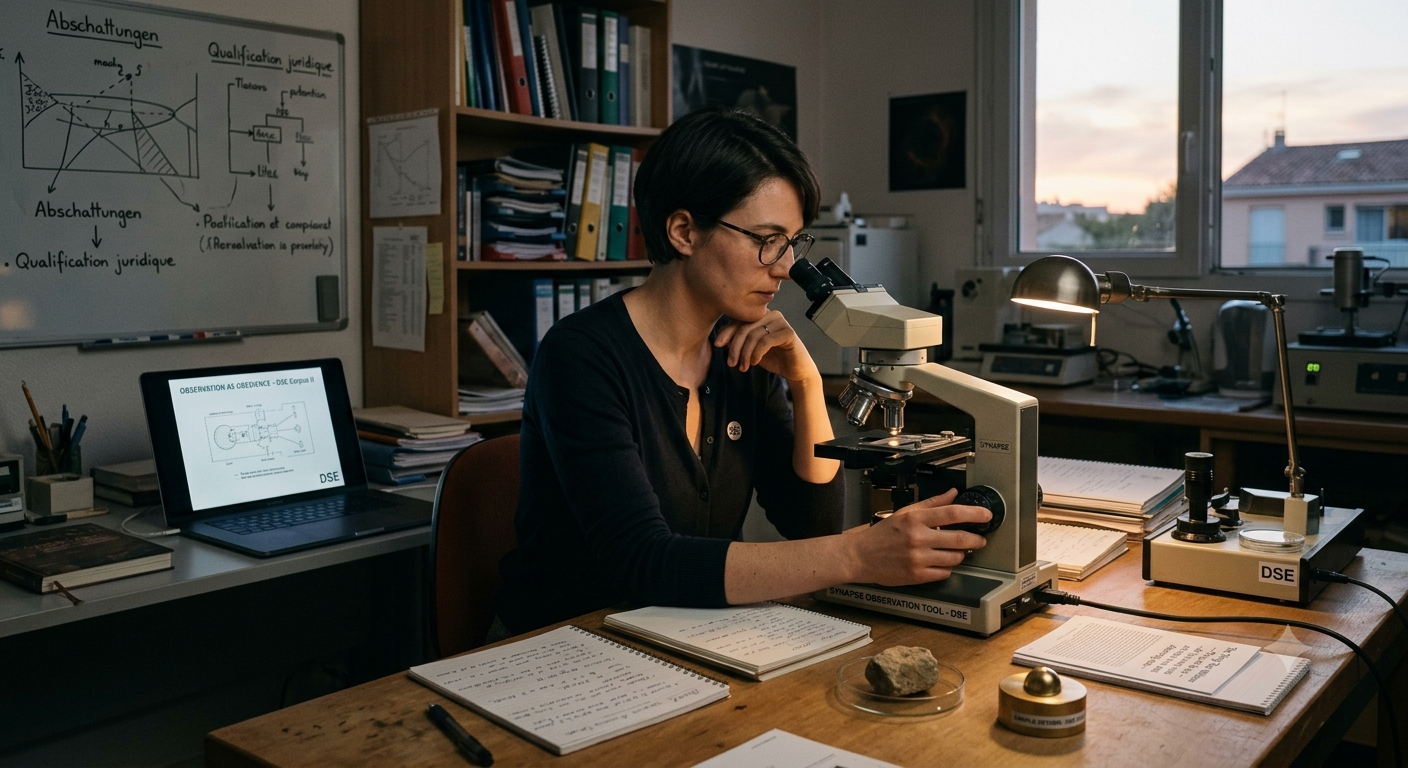
So the thing observed does not, in the end, let itself be observed. The apparatus of the age is arranged around this refusal without naming it. I mean to name it, and to name it we must first requalify a single word — but that comes last. In law, everything turns on qualification: name the fact wrongly and every consequence drawn from it is vitiated, however rigorous the reasoning that follows.1 We proceed in that spirit: name first, demonstrate after.
II. The eye alone
A single thread, pulled.
Take one element and one only: the eye. Not the whole apparatus of science, not the instruments, not the theories — the eye. Pull that thread and see how far it runs.
The eye does not emit. This was settled a thousand years ago, when the scholar of Basra overturned Euclid and Ptolemy, who had imagined vision as a ray leaving the eye to palpate the world. 2 The eye receives. It is a surface upon which the world writes, and it writes nothing back. This can be verified without instruments, in the body itself: stand outside with the eyelids closed, and colour floods in through the translucent lid; let a person step between you and the source, and the light dims. What you register is not what you send but what reaches you, and its absence when it is blocked. Reception, purely.
And what merely receives can receive anything, and believe it. This is the decisive consequence, and it is structural, not accidental. A receiver that cannot verify what arrives has no means of distinguishing a straight stick from a stick the water shows as broken, a true line from the arrowed line that seems shorter beside its twin. The optical illusion is not a failure of the eye; it is the eye working exactly as a receiver works. The passive receiver is credulous by construction. It cannot be otherwise, for to doubt what arrives it would need a second source — and it has none of its own.
A receiver that cannot verify is not deceived by accident. It is credulous by design.
III. The reinforcement that is none
More witnesses, one voice.
The obvious repair is to summon the other senses. The eye sees the stone; I approach, I confirm the ground beneath it, I touch — does it feel as the eye reported? I smell it; does an odour escape it, or is it mute to the nose? I set it to the tongue. Four more witnesses, and the truth, one wants to say, lies in their agreement. This is very nearly right, and its near-rightness is the trap.
For the other senses are receivers too, each as passive and as credulous as the eye, and — this is the sharper point — they do not set out on their own. The eye spoke first. It said there is a stone over there, and it was that first utterance which sent the hand to touch, the nose to smell, the tongue to taste. The other senses do not go to the stone the eye has not seen. They are not independent witnesses corroborating from without; they are witnesses summoned by the accused himself. The eye is at once the first witness and the one who chooses which further witnesses shall be questioned, and upon which object.
The opening ends here.
You have just read the part that poses the problem. That is deliberately where open access stops. The corpus is a personal research project carried on since 1998, and the question has always interested me more than the conclusion.
Want to publish your own articles?
Join the Digital Synapse Exchange community and share your research.